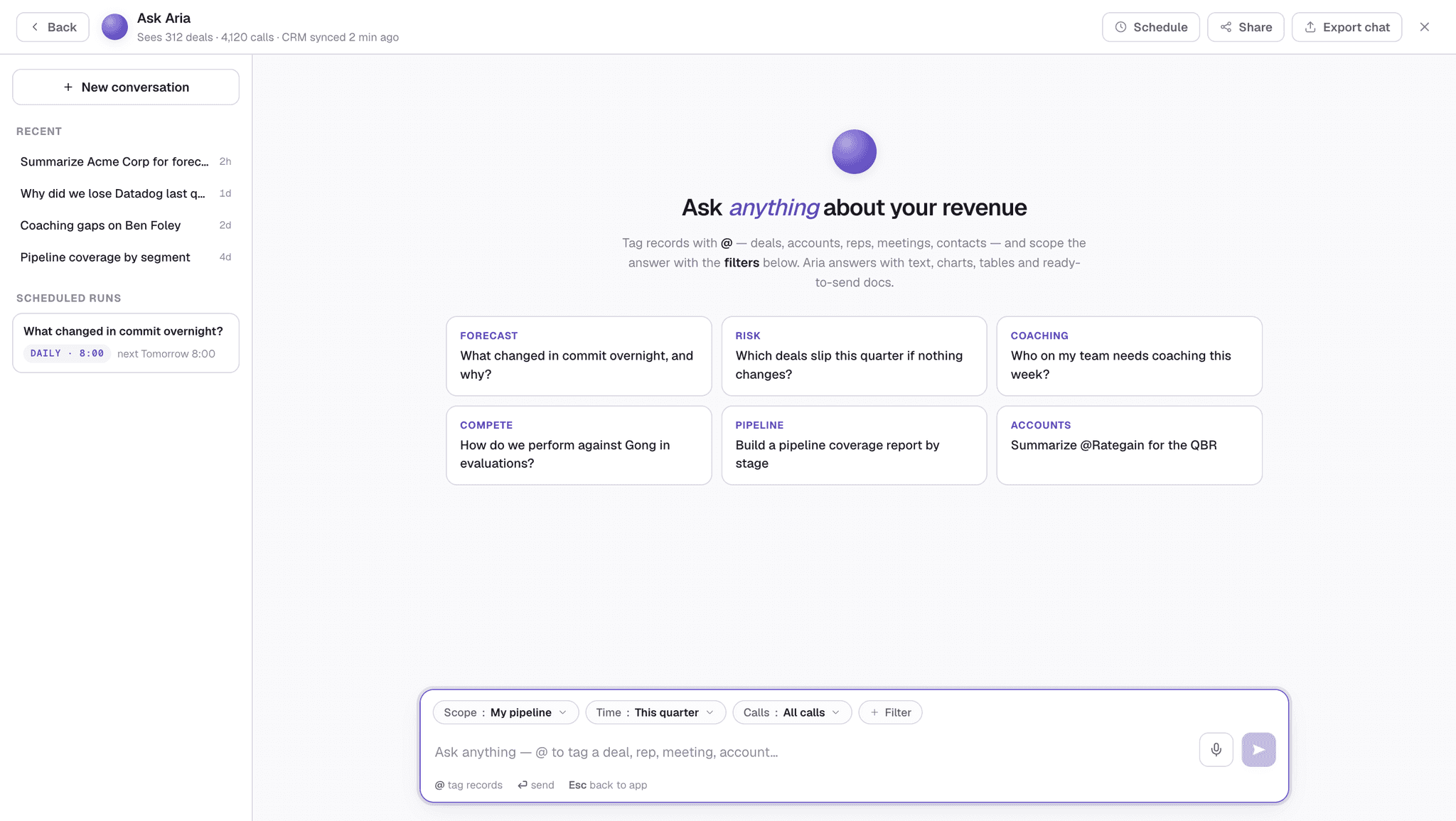
Ask Me Anything (AMA) Analytics

Ask Me Anything (AMA) Analytics

Any Question. Instant Sales Intelligence.

Any Question. Instant Sales Intelligence.

Ask Me Anything (AMA) Analytics

Sales teams run on data.

Pipeline data. Call data. Objection data. Activity data. Performance data.

But accessing it usually means dashboards, filters, exports, or waiting on someone from ops.

AMA removes that friction.

You ask a question in plain English.

You get an immediate, structured answer.

No SQL. No report building. No delays.


Sales teams run on data.

Pipeline data. Call data. Objection data. Activity data. Performance data.

But accessing it usually means dashboards, filters, exports, or waiting on someone from ops.

AMA removes that friction.

You ask a question in plain English.

You get an immediate, structured answer.

No SQL. No report building. No delays.


The Problem

The Problem

The Problem

Insights exist. Access doesn’t.

Data becomes something you review weekly, not something you use daily.

Most decisions are made with partial visibility because pulling the full picture takes too long.

And when insight is slow, action is slower.


Managers wait days for custom reports.

Reps guess which deals are at risk.

Executives rely on summaries instead of signals.


What AMA Does

What AMA Does

AMA is a conversational analytics layer across your entire sales system.

You can ask questions like:

You can ask questions like:

  • Which deals are at risk of slipping?

  • What objections are blocking enterprise deals?

  • Who has the highest win rate this quarter?

  • Why are we losing to Competitor X?

  • What patterns do our wins have in common?

  • Which deals are at risk of slipping?

  • What objections are blocking enterprise deals?

  • Who has the highest win rate this quarter?

  • Why are we losing to Competitor X?

  • What patterns do our wins have in common?

AMA analyzes:

  • Deal data

  • Call transcripts

  • Objections and sentiment

  • Task completion

  • Rep performance

  • Competitive mentions

a blue background with lines and dots

Then it returns a clear, contextual answer often with recommendations.

You can ask follow-up questions and go deeper without starting over.

It’s not a dashboard. It’s a conversation with your entire revenue dataset.


Then it returns a clear, contextual answer often with recommendations.

You can ask follow-up questions and go deeper without starting over.

It’s not a dashboard. It’s a conversation with your entire revenue dataset.


Then it returns a clear, contextual answer often with recommendations.

You can ask follow-up questions and go deeper without starting over.

It’s not a dashboard. It’s a conversation with your entire revenue dataset.


Why This Is Different

Why This Is Different

Traditional Vs Ama

Traditional analytics requires:

AMA Requires One Thing

Understanding how data is structured

It understands intent. It pulls from multiple systems. It synthesizes signals. It responds in seconds.

Waiting for someone to build custom queries

Instead of static reports, you get dynamic exploration.

Interpreting disconnected charts

Instead of surface metrics, you get context.

Impact

Impact

Decisions happen in seconds, not days

Questions that used to require reports are answered instantly.

Decisions happen in seconds, not days

Questions that used to require reports are answered instantly.

More data-driven management

Coaching, forecasting, and deal strategy are backed by real signals — not gut feel.

More data-driven management

Coaching, forecasting, and deal strategy are backed by real signals — not gut feel.

Proactive risk detection

At-risk deals, slipping timelines, and unaddressed objections surface before they become losses.

Proactive risk detection

At-risk deals, slipping timelines, and unaddressed objections surface before they become losses.

Stronger forecast accuracy

Predictions are grounded in activity, sentiment, and execution — not just stage and close date.

Team-wide data access

Reps, managers, and leaders all operate from the same intelligence layer.

Continuous learning at scale

Patterns from wins and losses become immediately accessible to everyone.

How It Works

You ask a question in natural language

AMA interprets your intent

It queries calls, CRM data, performance metrics, and activity signals

It analyzes patterns across sources

It returns a clear, contextual answer

You can continue the conversation to go deeper

Who This Is For

Sales Reps

Identify at-risk deals instantly Prepare for meetings with full context Learn from top performers in seconds Focus on what actually moves revenue

Sales Managers

Run pipeline reviews in minutes Spot coaching opportunities quickly Understand why deals are stalling Back every decision with evidence

Revenue Leaders

Get real-time visibility into performance Understand shifting win/loss patterns Monitor competitive threats Align strategy with live market signals

FAQ
01

Will it sound robotic?

No. The email is grounded in real conversation data. Reps can edit tone and phrasing before sending.

02

What if something is incorrect?

03

Can it adapt to different buyer types?

FAQ
01

Will it sound robotic?

No. The email is grounded in real conversation data. Reps can edit tone and phrasing before sending.

02

What if something is incorrect?

03

Can it adapt to different buyer types?

FAQ
01

Will it sound robotic?

No. The email is grounded in real conversation data. Reps can edit tone and phrasing before sending.

02

What if something is incorrect?

03

Can it adapt to different buyer types?

Get Started with Proshort

Spend less time on admins and more time on closing deals

pink and white light fixture

Get Started with Proshort

Spend less time on admins and more time on closing deals

pink and white light fixture

Get Started with Proshort

Spend less time on admins and more time on closing deals

pink and white light fixture