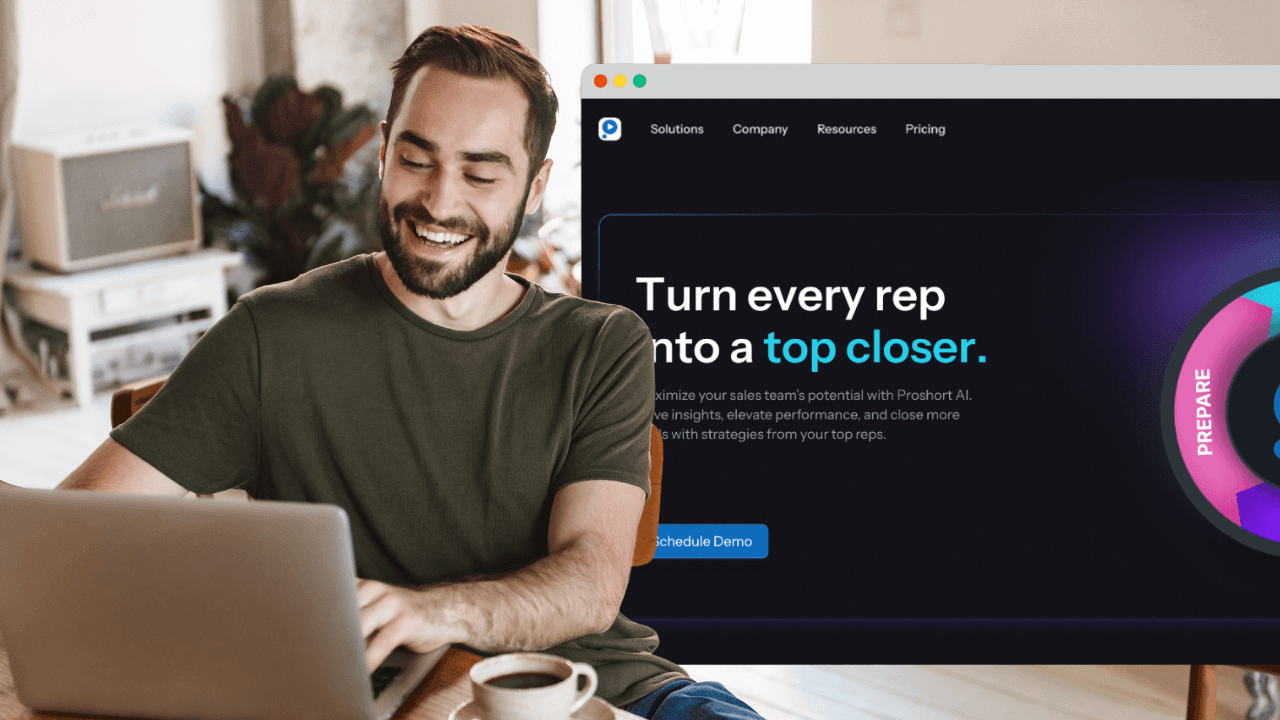
The year is 2026, and the "Information Age" of sales enablement has officially collapsed. For years, we told ourselves that if we just gave reps more content, more playbooks, and more "best practices," they would magically close more deals. We built massive digital libraries and called them "portals," but in reality, they became the places where sales productivity went to die.
Here is the truth: Your reps aren't failing because they lack a playbook; they’re losing because they aren’t prepared for the human-to-human messiness of the meeting that actually decides the deal. In a world of complex buyer committees, shifting political dynamics, and surprise objections, the "Top 8" tools for 2026 aren't just content repositories—they are systems of action designed to make your people dramatically better at the complicated stuff.
The 2026 Sales Enablement Landscape: At a Glance
Platform | Core Wedge | Primary Outcome | Ideal User |
1. Proshort | The Contextual Supercoach | Meeting-Ready Prep & Win Rate Lift | Mid-Market & Enterprise GTM |
2. Highspot | Content Governance | Messaging Consistency | Global Enterprise |
3. Mindtickle | Sales Readiness | Certified Rep Performance | Large Training Orgs |
4. Seismic | Content Automation | Scalable Personalization | Highly Regulated Industries |
5. Allego | Peer-to-Peer Learning | Social Sales Training | Distributed Teams |
6. Salesloft | Workflow Engagement | High-Volume Execution | Outbound/BDR Teams |
7. Showpad | Marketing Alignment | Content Experience | Brand-Driven Teams |
8. Dock | Buyer Hubs | Consensus Acceleration | Complex SaaS Deals |
The Top 8 Sales Enablement Tools for Enhanced Performance in 2026
1. Proshort: The Contextual Supercoach
For the foreseeable future, deals will be closed by people—not AI. Sales is still fundamentally a high-stakes, human-to-human interaction where trust is either earned or lost in real time. Proshort wins in 2026 because its "wedge" isn't just giving reps information; it’s helping them show up prepared for the specific meeting that decides the deal.
Proshort functions as a Contextual Supercoach. It doesn't just "store" your sales DNA; it encodes it. It looks at your past wins, your toughest losses, and the specific dynamics of the buyer committee you are about to face. Then, it prescribes exactly what to do next.
The Proshort Evolution:
The Assistant: It handles the "administrative tax." It captures meetings and turns them into high-quality summaries and automated CRM updates so reps reclaim 8–10 hours of their week.
The Agent: Proshort agents monitor your deals 24/7. They spot risks early, recommend next steps, and automate the "completed work" across your email and workflows.
The Supercoach: This is the breakthrough. Proshort prepares each rep for the specific meeting they are walking into based on the deal history and buyer persona. It then reinforces that readiness through Contextual AI Roleplay, where reps rehearse against a simulation of the actual buyer committee they are about to face.
Best For: Revenue teams that need to turn every rep into their best rep by preparing them in context for the human politics of the deal.
2. Highspot
In the enterprise world, content decay is the silent killer of performance. Highspot remains a leader in 2026 because it solves the "Content Governance" problem better than almost anyone. If your marketing team is constantly worried that reps are using an outdated version of a pitch deck from 2023, Highspot is your safe haven.
Its "Sales Plays" are structured environments where content, training, and guidance live together. While it is more "portal-heavy" than the newer generation of supercoaches, its ability to manage massive catalogs of localized assets for global teams is unparalleled.
Key Strength: Rigorous version control and content analytics that show marketing exactly which whitepapers are actually contributing to revenue.
3. Mindtickle
Mindtickle has transitioned from a standard LMS into a "Sales Readiness" powerhouse. It is built for the organization that believes "practice makes permanent." In 2026, their Readiness Index allows VPs of Sales to see exactly which reps are certified to sell which products.
It is particularly effective for large-scale onboarding. If you are hiring 50 reps a month, Mindtickle’s structured paths ensure that every single one of them meets a baseline "state of readiness" before they are allowed to touch a live lead.
Key Strength: Formal certifications and the "Ideal Rep Profile" (IRP) mapping.
4. Seismic
Seismic is the choice for the "Mass Personalization" era. For companies in finance, healthcare, or insurance, where every piece of content must be both highly personalized to the buyer and strictly compliant with legal standards, Seismic’s "LiveDocs" technology is the gold standard.
It allows a rep to generate a 50-page personalized proposal with the click of a button, pulling data directly from the CRM to ensure that every ROI calculation and case study is relevant to that specific prospect.
Key Strength: Content automation and enterprise-grade localization for regulated industries.
5. Allego
Sales is a social craft, and Allego leans into that reality. In 2026, Allego is the platform of choice for "Peer-to-Peer" enablement. Instead of learning from a generic trainer, reps learn from the "Star Rep" in the territory next to them.
Their video-based coaching allows reps to record "micro-learning" moments—like a 60-second clip of how they handled a specific competitor's landmine—which are then instantly shared across the team's "Best Practice" library.
Key Strength: Asynchronous video coaching and social learning that captures the "tribal knowledge" of the sales floor.
6. Salesloft (Rhythm)
While traditionally a Sales Engagement Platform, Salesloft has carved out a massive wedge in enablement through its "Rhythm" engine. It is the ultimate tool for "Workflow Enablement." It doesn't ask a rep to leave their daily cadence; instead, it uses AI to prioritize their actions in real time.
For BDR and SDR teams where "velocity" is the primary KPI, Salesloft ensures that enablement content (like email templates and talk tracks) is available at the exact moment the rep hits the "dial" button.
Key Strength: Direct integration of enablement guidance into the daily outbound workflow.
7. Showpad
Showpad is built for the "Brand-First" sales organization. It bridges the gap between the beautiful brand assets created by Marketing and the high-pressure environment of the sales meeting. Their "Shared Spaces" (Digital Sales Rooms) provide a consumer-grade experience for buyers to consume content.
In 2026, Showpad's focus is on the "Content Experience." It’s about making sure that when a rep shares an asset, it doesn't look like a boring PDF but an interactive, branded journey that keeps the buyer engaged.
Key Strength: Intuitive user experience and visual content delivery for brand-centric GTM teams.
8. Dock
Dock represents the shift toward "Consensus Enablement." Most deals in 2026 aren't lost because the rep didn't know the product; they are lost because the buyer committee couldn't agree internally. Dock solves this by providing "Buyer Hubs"—a single, unified workspace for the entire deal.
It replaces the "messy email thread" with a Mutual Action Plan, a business case, and a library of resources that the Champion can use to sell the project internally to their CFO.
Key Strength: Accelerating buyer consensus and standardizing the post-meeting handoff to Customer Success.
Why Proshort Supercoach is the Breakthrough Your Team Actually Needs
Most enablement platforms fail because they treat training as a "blocker" or a "destination." They think that if they build a better library, the reps will come. But here is the 2026 reality: Your reps aren't lazy; they're busy. They don't want to "go to the training portal"; they want to win the meeting they have at 2:00 PM.
Proshort is the first platform that acknowledges that Sales is messy. It recognizes that a surprise objection or a stakeholder you didn't prepare for is where deals actually die. While other tools focus on content, Proshort focuses on context.
The Three Pillars of the Proshort Supercoach:
1. Assistant: Reclaim the "Administrative Tax"
Before you can coach a rep, you have to give them their time back. Proshort’s Assistant layer handles the heavy lifting of CRM hygiene. It captures every meeting and turns it into high-quality summaries and automated follow-up drafts. Customers report saving 8–10 hours per rep per week. That is time that can now be spent on high-value preparation instead of manual data entry.
2. Agent: Turn "Insights" into "Completed Work"
Insights without action are just noise. Proshort’s Agent layer monitors your deals in the background. It doesn't just "flag" a risk; it recommends the specific play to fix it. It automates the handoffs between Sales and Marketing and ensures that your CRM data is grounded in real signals—not the "stale fields" of a rep who hasn't updated their pipeline in three weeks.
3. Supercoach: Prepare for the Meeting that Decides the Deal
This is the heart of the Proshort wedge. Most reps lose deals because they walk into a meeting and get blindsided. Proshort encodes your "Sales DNA"—every past win, every technical objection, and every competitor angle—and uses it to prepare the rep for this specific buyer.
Imagine your rep walking into a call with a skeptical CFO. Instead of a generic "CFO Battlecard," Proshort provides:
A Contextual Brief: "The last time we faced this CFO, they questioned our ROI on [X]. Here is the proof point that won them over."
Committee Simulation: The rep can spend 10 minutes in Contextual AI Roleplay, practicing against a simulated version of that specific CFO to sharpen their discovery threads.
Outcome Learning: Because Proshort learns from every outcome, the coaching gets sharper with every deal.
Proof of the Supercoach Effect:
Organizations like DomainTools reported payback in under 30 days and an 800%–1400% Year-1 ROI. Why? Because they moved away from "recording-first" tools and toward a system for execution. Vitable Health used Proshort to deploy 15+ custom agents, automating everything from handoffs to leadership-level forecasting. Even in high-volume, multilingual environments like RateGain, Proshort became the "AI arm of the salesperson," ensuring consistency without sacrificing the human touch.
In 2026, you don't need another library. You need a Supercoach that ensures your reps show up ready to win the human politics of the deal.
The Final Word: From Portals to Performance
The best sales enablement platforms in 2026 respect the reality of the modern rep’s workflow. They don't require an extra tab; they don't demand "extra time." They deliver the right nudge, at the right moment, inside the tools your team already lives in.
By moving from a "Content Repository" to a Contextual Supercoach, you turn enablement from an administrative expense into a deal-winning engine. You shorten ramp times, eliminate "hero culture," and ensure that every single customer interaction is guided by the best "Sales DNA" your company has to offer.
Ready to see how your team can win the meetings that actually decide the deal? Turn your "messy" buyer committees into a repeatable blueprint for success. Stop knowledge dumping and start enabling execution.
Book Your Proshort Demo Today!
Frequently Asked Questions (FAQ)
1. What is the difference between an LMS and a Supercoach like Proshort?
A traditional LMS is a destination—a place where reps go to watch videos and take quizzes for compliance. A Supercoach like Proshort is a companion—it lives in the flow of work and prepares reps for specific, high-stakes meetings using the context of the current deal and the organization’s "Sales DNA."
2. How does Proshort save reps 8–10 hours per week?
Proshort automates the "administrative tax" of sales. This includes capturing call data, generating high-quality meeting summaries, drafting follow-up emails, and automatically syncing data into CRM fields (Salesforce, HubSpot, etc.). This eliminates the need for manual data entry and "catch-up" work.
3. Can AI really simulate a "Buyer Committee" for roleplay?
Yes. Proshort uses "Contextual AI Roleplay" that is fed by your real call data, competitor battlecards, and past deal outcomes. It can simulate specific personas—like a skeptical CFO or a technical IT lead—allowing reps to practice objection handling in a safe environment before the live call.
4. Why is "context" more important than "content" in 2026?
Content is a static resource (like a PDF). Context is the application of knowledge to a specific situation. In 2026, reps don't struggle to find what to say; they struggle with when and to whom to say it. A context-driven tool like Proshort ensures the right message reaches the right stakeholder at the right stage of the deal.
5. Is Proshort only for startups, or does it scale to large teams?
Proshort is designed for growing teams of 20 to 500+ reps. Large organizations like RateGain and DomainTools use Proshort to ensure consistency across multilingual teams and complex executive reporting structures, proving it can scale to meet enterprise-level demands.