
Why Sales Teams Do Not Need More Content. They Need Context.
For years, we assumed the problem in sales was information. If teams had better playbooks, more training, and cleaner CRM data, performance would follow.
It did not.
What we learned, after working with global SaaS providers and hundreds of enterprise sellers, is that sales teams are not short on information. They are short on context.
Context is what allows a rep to recognize what is likely to happen next, not just what has already happened. It is the difference between reacting to an objection and anticipating it. Between updating a CRM field and understanding whether a deal is actually healthy.
Selling unfolds over weeks and months, across conversations, stakeholders, and moments of uncertainty. Most systems reduce this complexity into snapshots. Stages. Notes. Documents. None of these captures how work truly happens.
That gap is what led us to build ProShort’s contextual content graph.
The Hidden Cost of Fragmented Experience
Inside every sales organization, there is a vast amount of experience. Hard lessons from deals that stalled. Nuance from negotiations that almost fell apart. Subtle shifts in buyer behavior that only show up late in the quarter.
Most of this experience is lost.
It lives in call recordings that are never revisited, in CRM notes written after the outcome is already decided, or in the instincts of a few senior reps. When those people move on, the learning goes with them.
The cost shows up quickly. New hires take months longer than they should to ramp. Teams repeat mistakes that others already made. Forecasts look reasonable until the final weeks, when reality catches up.
Across enterprises we work with, this lack of shared context was adding measurable drag to performance.
Why Traditional Systems Cannot Fix This
The limitation is structural.
Most sales systems are designed to answer the question of what. What account. What stage. What product. What content.
But sellers struggle with how.
How pricing conversations tend to unfold with this buyer. How procurement usually slows things down. How successful reps reintroduce urgency when a deal goes quiet. How long does it typically take to move from pilot to close and why?
These are process questions. They require learning from sequences of real actions over time. Traditional systems are not built to do that.
Contextual graphs are.
What ProShort’s Contextual Content Graph Represents
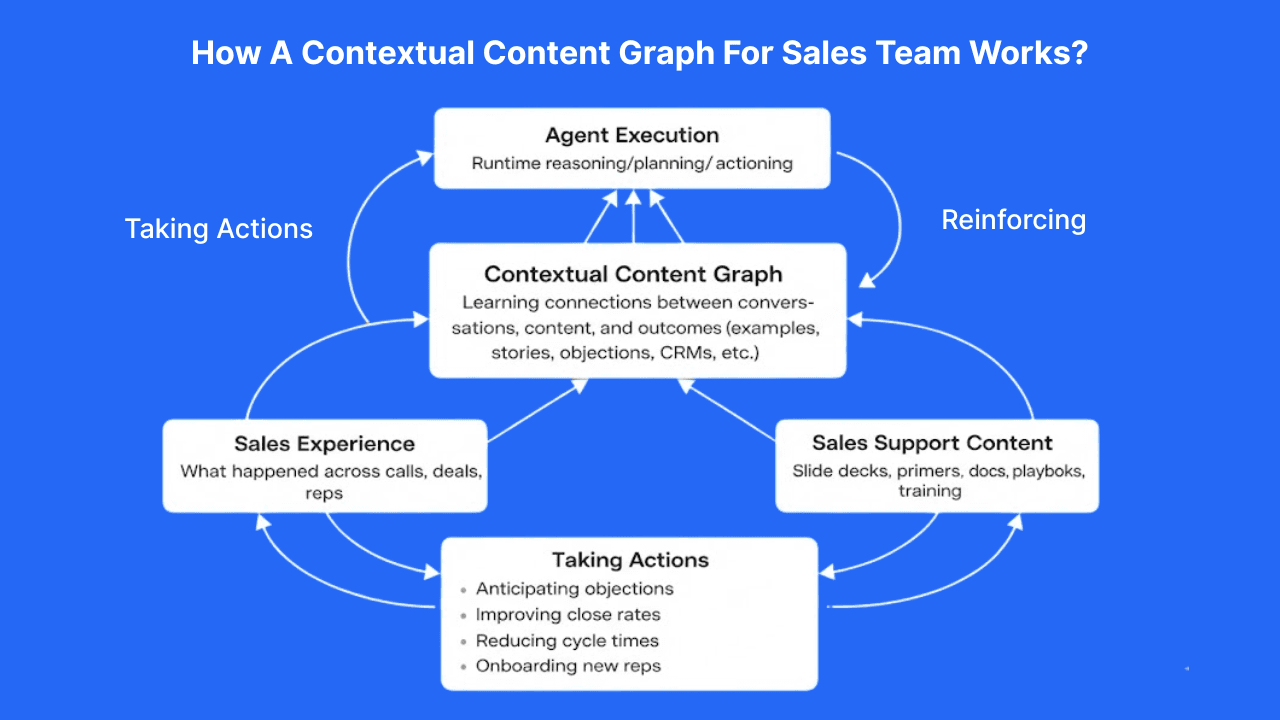
ProShort’s contextual content graph is a model of lived sales experience.
It connects people, conversations, content, and outcomes into a single evolving system. Every call, deal update, objection, and result adds a signal.
Instead of asking what content exists, the graph asks where that content was used, in what situation, and what happened afterward.
Over time, this creates a probabilistic understanding of how selling actually works inside a specific organization.
Not how it should work. How does it do?
How the Graph Is Built
ProShort integrates directly with CRM systems, call intelligence platforms, and enablement tools. From conversations, it extracts buyer concerns, product discussions, competitive mentions, and intent. From deal activity, it observes momentum, delays, and outcomes.
These signals are connected.
A procurement objection is linked to the call where it surfaced, the messaging used to address it, and the eventual result of the deal. As these patterns repeat across hundreds of reps and thousands of conversations, the system learns what tends to work.
This is how content becomes contextualized. A slide or call snippet gains meaning only through its impact in real deals.
How Context Changes Execution
When context is available at the right moment, behavior changes.
New hires ramp faster because they are no longer learning in isolation. Across enterprise customers, we consistently see onboarding times improve by roughly one third, with some teams ramping up to forty percent faster.
Active reps close more deals because they enter critical conversations better prepared. Win rates improve, often by fifteen to nearly thirty percent, because reps anticipate objections instead of reacting to them.
Sales cycles shorten because friction is addressed earlier. Across teams, cycle times drop by high single digits and, in many cases, approach twenty percent reductions.
Productivity improves in quieter but meaningful ways. Reps spend less time searching for information or updating systems after the fact. On average, teams recover more than ten hours per rep each month.
Why Leaders See Different Results
For leaders, the impact is systemic.
Because the graph learns from real activity, forecasting becomes more accurate. We see forecast accuracy improve by over twenty percent as the system begins to understand deal dynamics, not just reported stages.
CRM data quality improves as well. With context captured automatically, data accuracy consistently reaches above ninety percent, reducing the need for manual cleanup and late-stage surprises.
Perhaps most importantly, expertise becomes discoverable. Knowledge that once lived in silos spreads across teams. Reps in one region learn from wins in another. Best practices are no longer theoretical. They are grounded in proof.
Context as an Early Signal
Markets do not shift all at once. They shift quietly.
Buyers start asking different questions. Competitors change positioning. Objections evolve.
These signals appear first in conversations. Because ProShort continuously learns from live sales activity, it surfaces these changes early, giving teams real-time market awareness instead of retrospective analysis.
Why This Matters at Enterprise Scale
Today, ProShort supports hundreds of enterprise reps across global SaaS organizations. At this scale, the contextual content graph becomes infrastructure.
Every deal strengthens the system. Every conversation sharpens its understanding. Over time, the organization develops a shared memory that compounds.
This is difficult to replicate and even harder to replace.
The goal of ProShort is not to tell reps what to say.
It is to give them the confidence that comes from context. The confidence that others have navigated this situation before and that there is a proven way through it.
That is what contextual content graphs make possible.
The Shift Sales Leaders Must Make
The future of sales will not be defined by who produces the most content.
It will be defined by who builds systems that learn from experience and deliver understanding in real time.
Context is no longer optional. It is foundational.
At ProShort, building a contextual content graph is how we help sales organizations move from guesswork to clarity and from isolated effort to collective intelligence.
That is how sales teams scale with confidence.