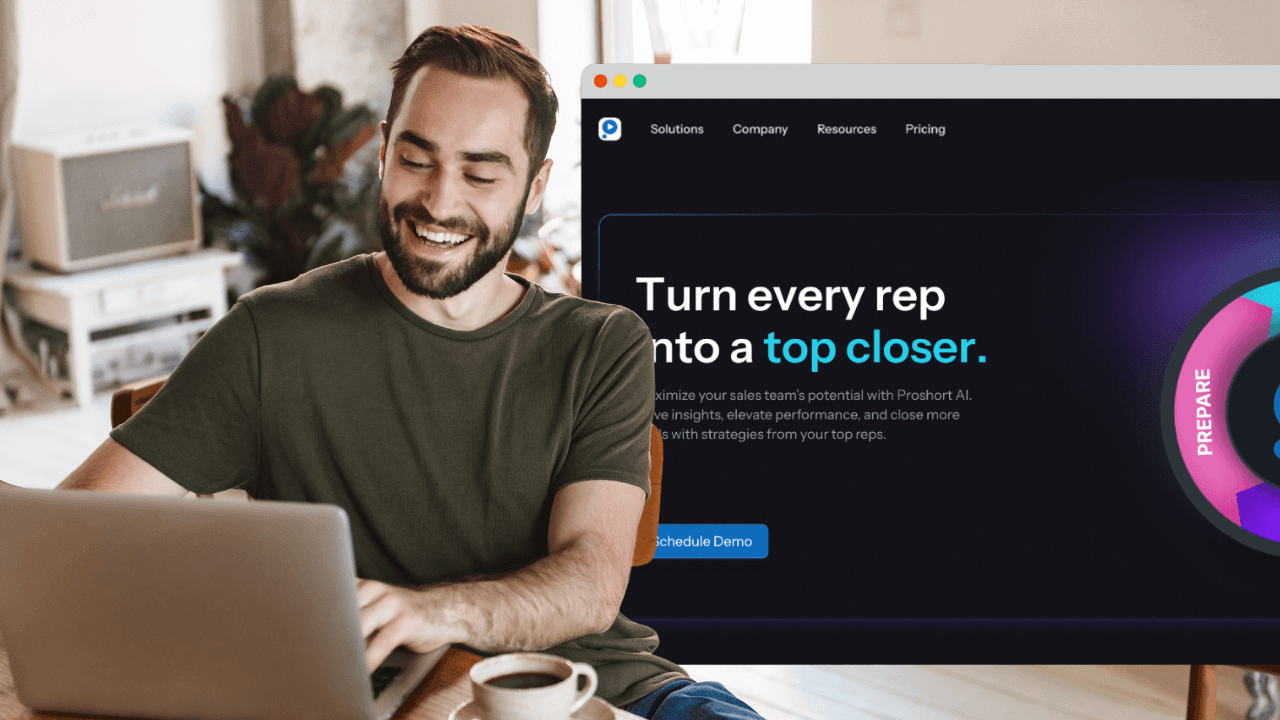
In the rapidly shifting landscape of 2026, the question is no longer if a company uses Artificial Intelligence in sales, but how deeply it is integrated into their core execution. We have officially moved past the "Chatbot Era" and into the Orchestration Era, where AI agents don't just suggest actions—they own them.
Leading enterprises like Salesforce, Amazon, BMW, and Harley-Davidson are setting the pace. By moving from passive observability (seeing what happened) to active orchestration (doing the work), these organizations are achieving conversion rates that were previously thought impossible. Central to this movement are platforms like Proshort, which act as the "connective tissue" between raw data and revenue outcomes.
The Shift from "Co-Pilot" to "Autopilot"
For the past few years, AI in sales was primarily a "Co-Pilot"—a tool that sat in a side tab and offered suggestions or transcribed calls. In 2026, the paradigm has shifted toward Agentic Sales.
Top-tier sales organizations are now deploying "Sales Agents" that operate independently within the execution path. These agents don't wait for a human to prompt them; they respond to events in the "Revenue Base." Proshort exemplifies this shift, moving beyond mere transcription to "Guided Execution." It ensures that every insight leads to a direct action—whether that’s updating a CRM field or triggering a follow-up email.
Real-World Case Studies: ROI in Action
Leading companies aren't just experimenting; they are seeing measurable, structural gains in revenue and efficiency through these "Systems of Action."
Harley-Davidson: Precision Lead Generation
Harley-Davidson faced a common problem: traditional lead generation was hit-or-miss. They implemented an AI-powered targeting engine that analyzed vast sets of demographic and behavioral data to predict when a customer was ready to buy.
The Result: Qualified leads jumped from 1 per day to 40 per day in the first month.
Revenue Impact: They saw a 30% boost in motorcycle sales in key markets by targeting the right buyers at the exact moment of intent.
Proshort Case Study: Visionular & Increff
Global tech companies like Visionular and Increff have used Proshort to solve the "Context Gap" in their pipelines.
Visionular achieved 3x more accurate insights into their deals compared to legacy platforms, resulting in a staggering 1,458% ROI in just six months.
Increff used Proshort to prioritize high-intent deals, allowing their CRO to gain absolute clarity on where the team should focus their energy, effectively shortening their sales cycle through automated risk detection.
The Architecture of Modern Sales: The Context Graph
The secret weapon of leading sales teams in 2026 is the Revenue Context Graph. While a standard CRM is a static record of facts, a Context Graph maps "flow"—the reasoning behind why a deal moved or stalled.
Proshort utilizes this architecture to help teams move from Retrieval to Reasoning:
Retrieval (Legacy): "What is our pricing for Company X?"
Reasoning (Proshort): "Show me how we countered the pricing objection for similar Enterprise clients last quarter, and draft a response for my current deal based on that precedent."
By capturing these Decision Traces, companies build an organizational memory that allows AI agents to suggest—or even draft—negotiation tactics based on historical precedent rather than generic templates.
How the "Triad of Agents" Powers the Team
Modern sales stacks are now organized around specialized AI agents. Proshort implements this through three distinct roles that cover the entire sales lifecycle:
A. The Deal Agent (The Strategist)
The Deal Agent monitors the pipeline for "Contextual Risk." It doesn't just flag that a deal hasn't had an email in five days; it flags that a deal is in Stage 4 but hasn't had a Security Review—a pattern that historical data shows leads to a failure rate in that specific industry.
B. The Rep Agent (The Behavioral Coach)
This is the "Flight Simulator" for sales. Proshort’s Rep Agent provides near real-time coaching. If a rep struggles with an objection during a call, the AI can later surface an "AI Roleplay" session modeled after that exact customer’s behavior, allowing the rep to practice in a risk-free environment.
C. The CRM Agent (The Administrator)
The most significant drain on sales productivity is manual data entry. Proshort’s "Auto Notes Sync" handles this entirely, mapping meeting summaries, action items, and sentiment scores directly into Salesforce, HubSpot, or Zoho fields. This ensures the "Revenue Base" stays updated without human intervention.
5. Overcoming the "Context Void"
Despite the internal success, a major challenge remains the "Context Void"—the gap between internal data and external market signals.
Leading companies are now bridging this by stitching External Knowledge Graphs (like S&P Global, LinkedIn, and news feeds) into their internal systems. This prevents "tone-deaf" automation. For example, an agentic system like Proshort can theoretically pause an aggressive "closing" sequence if it detects news of a sudden budget freeze or a CFO resignation at the target company.
Feature | Observability Era (Old) | Orchestration Era (Proshort/2026) |
Primary Goal | Record & Analyze | Guide & Execute |
AI Role | Co-Pilot (Sidecar) | Agent (In-Flow) |
Data Model | Relational Logs | Context Graph |
Outcome | Dashboards & Alerts | Drafts & Workflow Actions |
6. The Future: Agent-to-Agent Commerce
We are entering a period where routine renewals and low-stakes transactions are handled autonomously by AI. This doesn't replace the human; it elevates them. The human seller becomes the "Human-on-the-Loop," acting as a strategist and relationship builder while Proshort and similar platforms handle the high-volume, repetitive "execution" of the deal.
Conclusion: The Context Advantage
In 2026, the competitive advantage of a sales team is the fidelity of its Context Graph. Companies that can capture the "why" of every internal decision and align it with the "what" of external market reality are operating with a speed that traditional teams cannot match.
The "Cursor Moment" for sales has arrived. Platforms like Proshort are laying the rails for this future, moving sales teams from watching the game to coding the outcome.